
CyberHeed Agentic GRC and Compliance Automation.
Getting certified is not the same as being secure. CyberHeed builds both.
CyberHeed prepares, validates, and manages your compliance continuously with AI-guided workflows. Go from zero to audit-ready across NCA ECC, DESC ISR, DFSA, UAE IA, ISO 27001, and more, reducing manual effort and reliance on external consultants.

Most compliance ends at the badge. The security gaps stay open.
The GRC industry optimised for one thing: speed to certification. Organisations end up certified without having built the underlying capability, which means the certificate on the wall does not reflect the security posture behind it. When regulators, auditors, or an actual incident arrive, the gap shows.
Certified but not actually secure
Box-ticking gets you the badge but leaves real gaps in interpretation and execution. The certificate says one thing while the security posture underneath says another.

Manual evidence work that never ends
Collecting, mapping, and validating evidence by hand takes weeks, consumes expensive consultant time, and is out of date almost as soon as it is finished. Every audit starts the cycle again.
Every framework treated as a fresh start
Organisations facing NCA ECC, ISO 27001, and PCI-DSS often do the same work three times because their tools do not map controls across frameworks. Effort is duplicated instead of reused.
Prepare. Comply. Manage. One continuous loop.
CyberHeed covers the full compliance lifecycle through three connected stages. Each runs on the same platform and the same evidence base, so preparation feeds validation and validation feeds ongoing management without re-keying anything.

SmartPrep
AI-guided workflows that understand your context, establish your foundation, and surface gaps you did not know you had.

Evidence & AI
Evidence validated in minutes, not days. Every document scored, gaps identified, and mapped across every active framework.
Compliance Hub
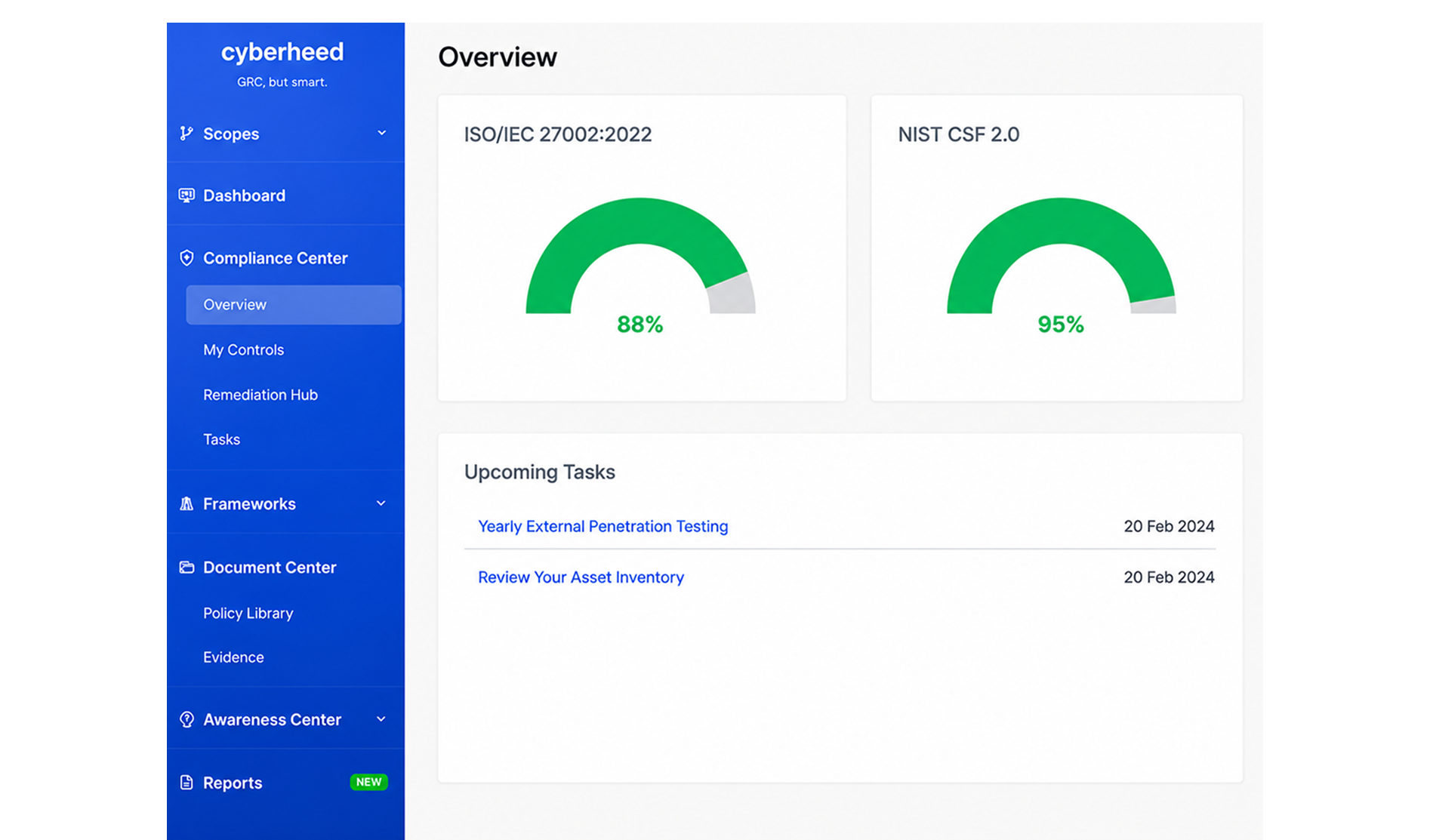
Helps you remain audit-ready. Gaps flagged before auditors find them, and board reports generated on demand.

Frameworks that matter in this region, plus the global and AI ones.
CyberHeed maps controls across frameworks, so what you do for one counts toward the next. That cross-mapping is where the time saving comes from, particularly for organisations in the Gulf that face regional, global, and increasingly AI-governance obligations at the same time.
What makes CyberHeed different from a checklist tool.
Agentic, not just automated
CyberHeed does not simply store your answers in a template. Its AI agents guide discovery, draft documentation, and validate evidence, doing the analytical work that would otherwise fall to a consultant or an overstretched security team.

Cross-framework mapping
Controls are mapped across every framework you run. Evidence produced for NCA ECC or ISO 27001 is cross-referenced and reusable wherever relevant, so you answer once and comply everywhere instead of repeating the work.
Evidence scored in minutes
Upload a document and CyberHeed scores it against the relevant controls, flags what is weak or missing, and tells you what to fix. Validation that used to take days of manual review happens in minutes.
Always audit-ready
Rather than scrambling before each audit, CyberHeed keeps your compliance posture live. Gaps are surfaced continuously and flagged before an auditor would find them, so audit time drops dramatically.
Board-ready reporting
Generate management and board reports on demand, showing real compliance status across every framework in language leadership can act on, without a manual reporting exercise each quarter.
Built for regulators and MSSPs too
Beyond single organisations, CyberHeed supports regulators overseeing many entities and MSSPs managing compliance for multiple clients, with aggregated views and multi-tenant management.







How a typical engagement looks
Scope
Onboard
Validate
Certify
Enable
Manage
Frameworks we help map to
Frequently Asked Questions
CyberHeed is an agentic governance, risk and compliance (GRC) platform for cybersecurity compliance. It uses AI-guided workflows to conduct structured discovery, generate tailored documentation, assess evidence, identify gaps and help organisations build and maintain audit readiness.
CyberHeed supports regional and international frameworks including Saudi Arabia's NCA Essential Cybersecurity Controls (NCA ECC), Dubai's DESC Information Security Regulation (DESC ISR), the DFSA Cyber Risk Management Rules, UAE Information Assurance (UAE IA), ISO/IEC 27001, PCI DSS and the NIST Cybersecurity Framework. It also supports ISO/IEC 42001 and the NIST AI Risk Management Framework for AI governance.
Agentic GRC uses AI agents that respond to an organisation's context instead of only following fixed, predefined steps. CyberHeed's AI agents guide discovery, help draft documentation, evaluate submitted evidence and explain where controls or documents need improvement. Human teams remain responsible for risk decisions, control implementation and final compliance approval.
CyberHeed maps related controls across an organisation's active frameworks. Evidence submitted for one framework can be cross-referenced and reused wherever it also satisfies requirements in another framework. This reduces duplicated assessment and evidence work, although requirements unique to each framework must still be addressed separately.
CyberHeed can assess many uploaded documents in minutes. The platform scores evidence against relevant controls, identifies weak or missing information and recommends what should be improved. Actual processing and remediation time depends on the document's size, complexity and the requirements being assessed.
No. CyberHeed reduces repetitive work such as discovery, documentation drafting, evidence mapping and initial validation. Internal specialists and advisers still provide professional judgement, implement controls and make risk decisions. Independent auditors or certification bodies remain responsible for formal audits and certifications.
CyberHeed is designed for organisations preparing for or maintaining cybersecurity compliance, including enterprises, government entities and regulated businesses. It also supports regulators that oversee multiple entities and managed security service providers (MSSPs) that manage separate compliance programmes for multiple clients.
The Kernel is CyberHeed's authorised distribution and enablement partner across the UAE and the wider Middle East and Africa region. The Kernel provides framework scoping, platform setup, onboarding, regional compliance guidance, evidence and audit preparation, team training and ongoing support.
Ready to build real compliance capability, not just a badge?

Talk to our team or book a demo. We will show you how CyberHeed maps to the frameworks your organisation faces and what a deployment in your environment would look like.