Webinars

What Security Buyers Will Ask Next
Security buyers are already asking harder questions, about AI adoption, identity, cloud visibility, compliance, and recovery readiness. In this session, we walk through the five conversations customers are starting to have, why each one is coming up now, and a real example of how one of our vendors answers it. Built for partners who want to walk into those conversations informed, not caught off guard.

Cybersecurity Adoption in MEA From the Inside
Most cybersecurity frameworks are sound, globally validated, and MEA regulators have built on them for good reason.
The gap is not in the standard itself. It is in what happens between the compliance checklist and actual operational resilience. Across the Middle East and Africa, that gap is often wider than organizations are willing to admit.
After years of working across the region with dozens of organizations, industries, and regulatory environments, The Kernel is opening a conversation that usually stays behind closed doors.
No product demos. No global templates repackaged as regional insight.
What we'll cover
- Why digital transformation across MEA is outpacing security maturity — and what that means for your organization.
- The three recurring patterns we continue to see across security deployments in the region that leave organizations exposed despite significant investments in tools and technology.
- What actually changes outcomes in MEA: the right approach, realistic implementation phases, and the stakeholder conversations that drive meaningful progress.
Join us for a practical discussion based on real-world experience from the region, focused on turning compliance into resilience.
Energy Logserver "You Can't Defend What You Can't See: Security Monitoring for AWS & Azure"
Deploying identity controls and email protection is only half the defense, the other half is knowing whether they're holding. This session shows how Energy Logserver turns cloud infrastructure logs into an active defense layer connecting the identity and email controls covered in previous sessions to a live monitoring and alerting capability that closes the DEFEND loop.
Key Takeaways:
- Why visibility is a DEFEND-layer requirement, not just a detection-layer one, and how cloud environments create blind spots
- How ELS centralizes AWS CloudTrail, Azure Monitor, and on-prem logs into a single correlated view
- A live demo: detecting suspicious login behavior and failed MFA attempts in real time, connecting directly to Yubico/Pointsharp deployments
- How to configure automated alerts for the most common cloud attack patterns: privilege escalation, unusual access hours, lateral movement
- How channel partners can position ELS as the "proof layer" that validates every other security investment their clients have made
The Enterprise MFA Roadmap: From Certificates to Full Passwordless
Most organizations sit somewhere between legacy passwords and true passwordless stuck with a patchwork of MFA methods that create user friction, compliance gaps, and security blind spots. Pointsharp's strength is in building the bridge: certificate-based authentication today, FIDO2 and full passwordless tomorrow, without forcing a rip-and-replace of existing identity infrastructure. This session is designed for IT decision-makers who have started the MFA journey but aren't sure how to reach the finish line at enterprise scale.
Key Takeaways:
- The four stages of MFA maturity, and how to identify where your clients currently stand
- Why certificate-based authentication is the right foundation for organizations that can't move to full passwordless overnight
- How Pointsharp's platform supports FIDO2, smart cards, mobile MFA, and certificates under one management layer
- The compliance requirements (NIS2, PDPL, ISO 27001) that are driving urgency around strong authentication in MEA
- How to differentiate Pointsharp's roadmap approach from point solutions when talking to prospects
Stopping Password Sharing and Concurrent Sessions Abuse in Real AD Environments
This session explores why password sharing persists in many organizations and how to address it with both cultural change and technical controls in Active Directory. Using real-world examples, we will show how to limit concurrent logins, control initial access points, and apply workstation, OU, and IP-based restrictions to attribute every session to a unique identity.
Key Takeaways:
1. Understanding the everyday reasons users share passwords and how this behavior undermines accountability and security.
2. How to configure concurrent session limits and single-point-of-entry rules so the same account cannot be used from multiple machines at once.
3. How to apply context-aware restrictions (workstation/OU/IP/time) in AD to stop careless behavior, prevent unauthorized use of stolen credentials, and ensure all access is attributable to one user.
Defense playbook against domain impersonation
Description As of 2026, 78% of domains have a DMARC record, but only 42% are actually enforcing it, leaving a 36-point enforcement gap that attackers are actively exploiting. Closer to home, 31% of MEA's top companies have zero DMARC protection, and another 68% are stuck at monitor-only mode; meaning they can see attacks happening but aren't stopping them. This session shows exactly what domain impersonation looks like in the wild, why "having DMARC" is not the same as being protected, and how Skysnag takes organizations from vulnerable to enforced in 30 days, not months.
Key Takeaways:
- How attackers exploit the gap between DMARC awareness and DMARC enforcement in MEA organizations
- The real cost of domain impersonation, from BEC fraud to brand damage and email deliverability collapse
- A live walkthrough of what a DMARC audit reveals in 10 minutes using Skysnag
- The 30-day roadmap from p=none to p=reject without breaking legitimate email flows - Why Google, Yahoo, and Microsoft's enforcement mandates make this a now-or-never conversation for your clients
EgoMind X Yubico " From Zero to Zero Trust: Deploying Passwordless Authentication at Scale"
Passwords are no longer failing quietly since the start of 2025, over 16 billion passwords have been compromised worldwide, and in 2026, automated agents are leaking more passwords than people. Yet 92% of enterprises know passwordless is the answer but struggle with one question: how do we actually roll it out? This session brings together Yubico and EgoMind to answer exactly that: Yubico covers the why and the hardware foundation, EgoMind covers the how of deploying, managing, and enforcing YubiKeys at scale across your organization.
Key Takeaways:
1- Why FIDO2 hardware keys are the only phishing-resistant MFA that holds up against today's AI-powered attacks
2- How to go from first YubiKey purchase to organization-wide deployment without disrupting operations
3- How EgoMind's Appterix platform automates YubiKey lifecycle management, provisioning, lost key workflows, and offboarding
4- What Zero Trust Application Access looks like in practice: apps that only launch when the right key is present
5- How to build the business case for passwordless authentication for your clients' leadership teams
Energy Logserver "SIEM and SOAR integration"
This session shows:
1. Faster incident response - learn how to reduce reaction time from hours to minutes
2. Operational efficiency - automate repetitive SOC tasks and free up your analysts’ time
3. Seamless SIEM–SOAR integration - understand how to extend your current SIEM capabilities
4. Stronger decision-making - leverage automated playbooks to standardize and improve responses
5. Improved threat mitigation - see real-life scenarios of stopping ransomware and phishing faster
6. Reduced human error - minimize manual mistakes through consistent, automated workflows
7. Better scalability of your SOC - handle more alerts without increasing team size
8. Actionable best practices - get ready-to-use ideas you can implement right after the webinar

EgoMind "Automating YubiKey Lifecycle from Day 1 to Deprovisioning"
Join the experts at EgoMind and The Kernel for an exclusive technical deep dive into Appterix. We’ll demonstrate how to wrap a robust Zero Trust solution around your MFA-hardware token.
Key Takeaways:
1)From Manual Chaos to Zero Trust: Discover how to transition to a scalable, automated Zero Trust architecture.
2)The Lifecycle in Action: Watch a live demo of the Appterix solution handling self-service YubiKey Enrollment, remote YubiKey LifeCycle Management, and instant lost and found functionality - no help desk required.
3)The "Swiss Knife" Strategy: Learn how Appterix can help you combine different identity and data protection measures in a holistic way!
Energy Logserver "Compliance Made Simple: From Manual Audits to Automated Dashboards"
In this session, we dive into Energy Logserver. We will demonstrate how to transform raw log data into real-time, automated compliance dashboards. Learn how to sell "Peace of Mind" by giving CISOs immediate visibility into their compliance status.
Key Takeaways:
1) The Audit Pain: Identifying the hidden costs of manual log management.
2) The ELK Stack Advantage: Understanding the power and flexibility of Energy Logserver’s architecture.
3) Visualizing Value: A look at pre-built dashboards that answer auditor questions instantly.
Skysnag "DMARC Enforcement Without the Chaos"
In this session, we will show you how Skysnag changes the conversation. Skysnag replaces the manual "Monitor and Pray" approach with intelligent automation that enforces DMARC protection without breaking email deliverability.
Key Takeaways:
1) The "Chaos" Problem: Why traditional DMARC projects take months and often fail.
2) The Automation Fix: How Skysnag automates SPF/DKIM management to achieve enforcement in weeks, not months.
3) Selling "Set and Forget": How to position this as a quick-win solution for brand protection and compliance.
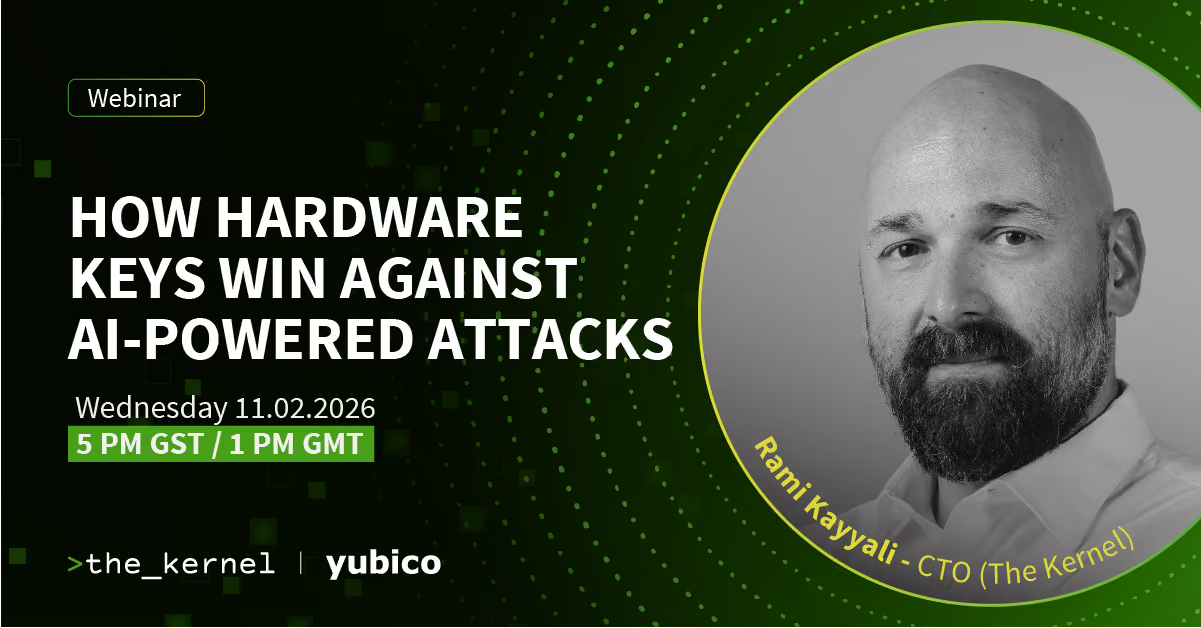
Yubico "How Hardware Keys Win Against AI-Powered Attacks"
Join The Kernel and Yubico for this partner enablement session. We will explore the technical reality of AI-powered phishing and demonstrate why hardware-backed security (FIDO2) is the only architectural answer that removes the human element from the risk equation.
Key Takeaways:
1) The Threat Evolution: Understanding how AI bots bypass SMS and "Push" notifications.
2) The Hardware Advantage: Why "Origin-Bound" cryptography makes YubiKeys mathematically un-phishable.
3) The Partner Pitch: How to calculate ROI for your clients by factoring in the elimination of help-desk password resets.
Pointsharp "Identity Is the New Perimeter"
Join us to learn how Pointsharp bridges the gap between Building Zero Trust Architecture and ripping out Your Infrastructure. We will discuss how to layer modern Multi-Factor Authentication and Access Management over legacy infrastructure, giving your clients a "Zero Trust" posture without the need for a "Rip and Replace" migration.
Key Takeaways:
1) The Hybrid Dilemma: Securing on-premise assets (SharePoint, IIS, Mainframes) with modern MFA.
2) Data Sovereignty: Positioning Pointsharp for clients who cannot legally use cloud-based Identity Providers (IdP).
3) The Login Experience: How to modernize the user experience without upgrading the backend.
Want these in your inbox?

We publish practical, vendor-neutral writing on identity, authentication, and security operations in the region. No spam, no hard sell.